

Why I Built Serenity & Sweet Tea
Why I Built Serenity & Sweet Tea
There's a version of this post where I tell you Serenity & Sweet Tea started as a business plan — a market gap I spotted, a niche I researched, a spreadsheet with projected revenue. That's not what happened.
It started with my Daddy.
He's been my whole world since birth. My first love, if I'm honest — when I was four or five years old, I told my Mama, adamant as could be, that when I grew up I was going to marry Daddy. She'd just giggle. He was my best friend and my confidant growing up, a man who worked two jobs, always, to make sure his family had what it needed.
So when my Mama passed away, I didn't give it a second thought — of course Daddy was going to come live with me. I knew his memory had been worsening, but I had no idea what kind of roller coaster we were about to ride. A dementia diagnosis. Then bladder cancer. Then an aneurysm. Then liver cancer. One after another, stacking on top of each other, over five-plus years of me being his primary caregiver.
I do not regret a single day of it. But I'm not going to sit here and tell you my body, my mind, and my wallet aren't completely exhausted, because they are.
That's the truth this whole brand was built on top of.
If you're here, there's a decent chance you know some version of this season yourself. You're an adult child caring for an aging parent — maybe your mother, maybe your father — while still trying to hold together your own home, your own job, your own family. You didn't apply for this role. Nobody trained you for it. And somewhere in the middle of doctor's appointments and medication schedules and quiet exhaustion nobody else sees, you probably found what I found: a caregiving world full of clinical checklists, and almost nobody actually talking to you like a real person going through a real thing.
I looked for community and came up mostly empty. I looked for resources that understood the emotional weight of this — not just the logistics — and mostly found silence, or worse, cheerful advice that didn't seem to have lived through anything like this at all.
So I built the thing I wished existed.
Why "Serenity & Sweet Tea"
The name is exactly what I needed most in the hardest parts of this season: a little bit of peace, and someone to sit with me a while. Not a lecture. Not a checklist shouted at me from a place of theory. Just a porch, some sweet tea, and a little bit of honesty.
That's what I want this place to be for you.
What lived experience actually means here
There's no shortage of caregiving advice online, and a lot of it is well-researched and well-meaning. But there's a difference between advice that comes from studying a situation and advice that comes from living inside it — the 2am moments, the guilt that shows up uninvited, the strange grief of watching someone change in front of you while they're still here.
Everything on this porch starts from that lived place first. Not instead of good information — but underneath it, holding it up.
What you'll find here
This isn't going to be a place that pretends caregiving is a tidy, inspirational journey. It's going to be honest about the hard parts, practical about the logistics, and warm about all of it. You'll find:
A free weekly letter — the Porch Light Post — with real talk and practical help
A blog full of stories, systems, and reflections from someone who's actually been in it
A podcast, The Porch Light Circle, for the drives to appointments and the folding-laundry hours
Digital tools built to make the coordination side of caregiving a little lighter, starting with the Family Huddle Kit
Eventually, a paid community for those who want to go a little deeper
If this is you
If you're reading this in the middle of your own hard season — whether it just started or you've been in it a while — I'm glad you found your way here. You don't have to have anything figured out today. You just have to be here.
The porch light is always on. Come sit awhile.

HEY, I’M MEREDITH...
I've spent over five years as my Daddy's primary caregiver — the doctor visits, the late nights, the moments nobody warns you about. Serenity & Sweet Tea is the porch light I wish had been on for me when I started this journey: real stories, honest support, and a little sweet tea for the road. If you're in the trenches too, pull up a chair. You're not alone here.


JOIN MY MAILING LIST
The Emergency Info Sheet Every Caregiving Family Should Have Ready
Quick gut check: if you got a call tomorrow and someone else had to step in for you — a sibling, a friend, a neighbor — would they know what to do?
I'll tell you about the Saturday morning I needed exactly that. Daddy had dealt with kidney stones more times than I could count over the years, so when he mentioned discomfort, that's what I assumed we were dealing with again. But helping him up from his shower chair that morning, I noticed a lot of blood — on the chair, still leaking as I got him dried off and dressed. He was weak, everything was taking twice as long as usual, and his mind felt further off than normal. One sister was at work, the other out of town. I called my brother, panicked. He came right over and took Daddy to the ER — I sent him with Daddy's notebook, the one with all the medical info and cards in it, while I showered and pulled myself together enough to follow. I was so thankful he answered my frantic voicemails and texts that morning. That was the Saturday we received Daddy's bladder cancer diagnosis — another diagnosis thrown into a mix that already felt impossibly full. That one left me more numb and more terrified than even the dementia diagnosis had. The fear of losing him set in all over again, and I found myself mourning him — right there, still very much alive — for what felt like the second time.
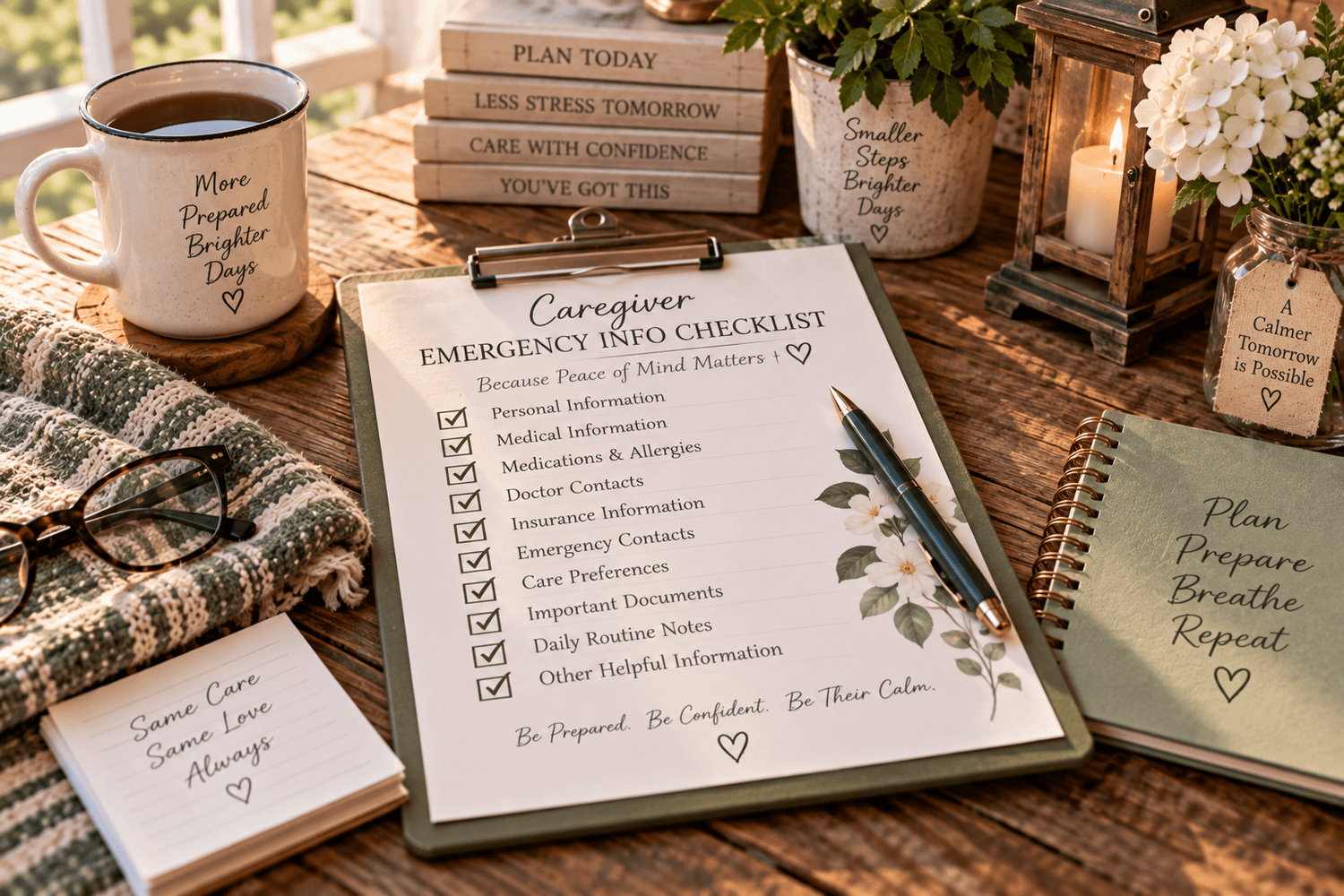
This week's tool is simple, but it's one of the highest-value things you can put together: a one-page emergency info sheet, kept somewhere visible, so anyone stepping in has what they need without calling you first.
What to Include
Full name and date of birth
Primary doctor and phone number
Current medications and dosages
Allergies
Emergency contacts, in order of who to call first, second, third
Insurance information and ID numbers
Nearest ER or preferred hospital
Any DNR or advance directive information, and where the physical documents are kept
Anything a substitute caregiver needs to know — routines, triggers, preferences that aren't obvious to an outsider
Where to Keep It
Visible and accessible matters more than fancy. The fridge. A binder by the door. A shared document everyone in the family can pull up on their phone. The goal is that in a moment of panic, nobody has to search, guess, or call you first to find it.
Why This Matters More Than It Seems To
In an emergency, adrenaline makes even simple information hard to recall — for you, and especially for someone less familiar with the day-to-day details. A prepared sheet removes that burden entirely. It also means you're not the single point of failure; if you're the one who's unreachable, unwell, or simply unavailable in a given moment, care can still continue without a dangerous information gap.
A Small Effort, a Big Peace of Mind
This isn't a project that takes long to build — most of it can be filled out in under an hour. But it's the kind of thing that's easy to put off indefinitely, right up until the moment you desperately need it and don't have it.
If you haven't built one yet, consider this your nudge. Not because something bad is imminent, but because peace of mind is worth an hour of your time.
The porch light is always on.